Fighting the Second Language Summer Slide


Summer is almost here and our students will be stepping out of the language learning classrooms ... will they spend two months forgetting about their second language? Let's fight the second language Summer Slide!

We can give our students and their families suggested tasks to complete during the summer months.

1. Give a BINGO summer homework sheet like this and when they bring it back the first day of school give them a prize! List things the children have learned to do during the year like name 3 colors or name 3 school objects, etc on the BINGO sheet.

2. Give the families a few apps you recommend the students use. I usually suggest Duolingo or Rosetta Stone. What are your favorites?

3. Suggest to the families that they use italki.com to find a language partner or a low cost native speaker teacher/tutor. On this site you can find someone wanting to learn English and set up a time to talk on Skype (or using another way to connect if you prefer). Then speak one language for half of your exchange, and the target language for the other half. You can also find many low cost teachers or tutors to speak with or give you a lesson.

4. Suggest that the family uses lingoo.com and organize a language exchange! My family has used the site and we've welcomed a German girl to our home (she came twice!) and two French girls. We did a paid stay a couple of times and then an exchange. My daughter spent three weeks last summer speaking French at her language partner's home!

5. Encourage the families of your students to travel! And better yet, take language classes when they travel! My whole family has gone twice to Coeur de France in Sancerre, France, and we love it there! A friend of mine works at Prestige Idiomas in Rosas, Gerona, Spain, and it would be a great destination for Spanish learners!

6. Send home readers your students can read and re-read during the summer. Use audiopal.com or vocaroo.com to record yourself reading the stories and then send home links to the recordings along with the readers. Or post the links to your audio recordings on your class/school website.

What do you ask your students to do during the summer to not forget all they've learned? Comment below with your suggestions!


Quick and Easy Make Your Own Chocolate Poisson d'avril


Today we are making easy chocolate fish to celebrate le poisson d'avril!

If you do a google search for moldable chocolate or modeling chocolate, you'll find many recipes. The first one I tried was a messy disaster. 10 seconds into trying to form a fish, my hands were covered in chocolate and I just wanted the goop out of my hands. Next I tried a recipe from allrecipes.com called Plastic Chocolate. I figured if it had the name plastic in it, that would mean I'd have a more sturdy dough, and I was right! I had trace amounts of chocolate on my hands after making a fish with this dough.
#ICan'tHandleChocolateEverywhere

The dough is made up of two ingredients; corn syrup and chocolate.

You melt the chocolate and then mix in the corn syrup. You'll end up with a thick lump of chocolate deliciousness.
#Yum
Then you'll put the candy on plastic wrap to cool. The recipe tells you to wait 5 hours for it to cool and suggests that overnight is best. I waited 1 and a half hours and found mine sturdy enough to begin making my fish.

Give each student a piece of dough. I wanted mine to be large enough for the students to decorate, so I made a generous sized ball - maybe slightly smaller than a golf ball. If you make them this size, the recipe will be enough to make 12 fish.

Demonstrate with your own fish before having the students start.

First roll the candy in between your hands to form a ball.

Now start forming your fish by pinching to form a tail.

Keep pinching and molding the candy until you have a fish shape.


You can hand out toothpicks and let the students make scales and a mouth if they'd like.
You can also give them sprinkles or other small candies to decorate their fish.
And now comes the best part. Time to eat! I read that this recipe gives you a tootsie roll-like candy. I'm not a huge fan of tootsie rolls, but yuuuuuuum! These fish are so good!
#I'tsNotReallyLikeATootsieRoll

I'd love to see photos of your students' best creations. Please share!

Spring Activities for Spanish & French Classes


With spring coming up just around the corner, I've compiled some fun spring related activities for French and Spanish class!

1. Take a nature walk! Have your students collect objects in nature ~ things like blades of grass, wildflowers, pieces of bark...
After the walk, return to class with the collected objects. Give each student a photocopy page with the numbers 1-5 on it (you can make the activity harder by using the number words spelled out without the numerals). Students will place the correct number of objects into each numbered area of the page. Have them glue the objects to their pages.
If you are not able to take the class outside for a nature walk, have available objects typical of spring for students to sort and count. They can use seeds, photographs of birds, paper or silk flowers ...

2. For Spanish class, learn a spring poem. For French class, make a Mardi Gras mask.

3. Spring is the perfect time to talk about gardens, plants, vegetables ...  As a part of a garden/vegetable unit, I love to do the celery science experiment. But this Walking Water experiment looks super cool too! It would be a great way to review colors.

4. Eat the parts of a plant! It would be quick and easy to create your own version of this activity in Spanish or French.

5. Play a game outside! In Spanish class you can play Rayuela and in French class, play la Pétanaque.

What are your favorite Spring lesson plan activities? Comment below!


World Language Class Valentine's Day Craftivity


I'm using Shrinky dinks again! I loved them when I was a child and I still do!! This time we are using Shrinky dinks for a Valentine's day craftivity.

This is what we are going to do ...

1. We are going to use a freebie from Teaching 4 Real. To use the same image and size as me, use my printable found here. If you use my printable, the finished product will measure about 2 inches by 2 inches.

2. You'll need Shrinky dink film. I used the clear kind found here. With the clear film you will need to use permanent markers. If you buy the frosted kind with the rough side, you can use colored pencils. Find the frosted kind here. 
Or use this super inexpensive method using recycled materials in place of buying the film {I've never tried this but it looks cool!}

3. Give each student a printed heart and a piece of Shrinky dink film. The students will trace and color their hearts. You can give them options for what to write in the rectangle in the target language, or give them all just one sentence to write such as "Je t'aime." or "Te quiero."


4. If you want to make the craft into a necklace or key chain, hole punch the hearts after coloring. Now you are set to bake the names using the shrinky dink directions {or the BabyFirst directions if you are using the super inexpensive method}.

5. After baking you are set to make them into necklaces or key chains, or use them to create Valentine's day cards.

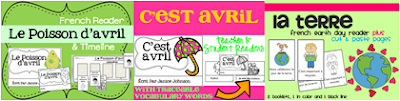
Ready to continue the party? Select the image below for February readers and other items!


Strategies for Reading to Language Learners


We've talked about why we should read to second language learners. But what are some good strategies for reading? What can we do to allow early language learners to participate in the read aloud?

1. Choose simple and basic stories. Complicated texts or stories with too much unfamiliar vocabulary will just discourage students.

2. Read stories the children are already familiar with. Since they'll already have the gist of what happens in the story, they won't get lost. They'll be more easily able to pick up new vocabulary and sentence structure.

3. Read the story multiple times during a week. Students need exposure over and over to new vocabulary. As you read a 3rd, 4th, ... time, pause now and then and allow the students to complete the sentence.

4. Use a variety of methods to help students understand the vocabulary in the story. Use gestures, your facial expressions, point to illustrations, provide extra illustrations and/or manipulatives when you can. During your 3rd, 4th, ... time reading the story, let the students be the ones to participate in the reading through use of gestures, facial expressions, or use of the extra illustrations and/or manipulatives.

5. Ask questions as you read. "Where is _____?" "Is she happy?" "Does she want to ____?" Give your students the opportunity to use new and previously learned vocabulary.

6. Once you've read the story several times, let your students act it out. They love this! Encourage them to retell the story.

7. Provide them with their own readers to read on their own. Or use audio books along with student readers so they can read along with the audio.


Why Read in the Early Language Learner Classroom

Why Read in the Early Language Learner Classroom

I've always loved to read to my language students as a part of almost every lesson ~ just like I always read to my daughters when they were little. I love it and so do my students ... but I did some thinking and reading about why reading to second language learners is important. Here are 5 reasons to read to your second language students:

1. Reading helps our students learn new vocabulary. Often stories repeat words and patterns and this is especially helpful to our students. Images in the stories also visually reinforce vocabulary.

2. Listening to someone read helps our students learn correct pronunciation.

3. Listening also helps students to pick up the rhythm of the language.

4. Reading to our students leads to conversation ... we can relate the stories to our own lives, describe illustrations, ask questions about what happens in the stories and make predictions.

5. Reading reinforces spelling ~ find simple stories your students can read on their own.

Why do you feel reading to second language learners is important? Comment below!

FREEBIE included! ~ Teaching Grammar in Context to Language Learners

Teaching Grammar in Context to Language Learners

Teaching students grammar rules isn't the only way to increase proficiency in the target language. The students can't just learn ABOUT the language. They also need to develop skills with USING the language. We need to make good decisions when choosing materials and classroom activities ... to first bombard our students with comprehensible input using a particular grammar focus, and then pushing our students to use the language.

1. Choose appropriate comprehensible materials for students to read, listen & watch the language being used in context. 

2. Play games using the new grammar structures. Here are some game ideas and I like these a lot too.

3. Provide students the opportunity to write in a controlled manner. I like using build-a-books ... and I want to share a build-a-book freebie with you! {including directions for how to use them}. Find the Spanish build-a-book freebie here, and the French build-a-book freebie here.

If you like the build-a-book concept and would like more, find all of my French build-a-books here and my Spanish build-a-books here.

Is there a build-a-book you need and don't see available? Comment below and I'll add it to my to do list!